ReWallet's Key Findings:
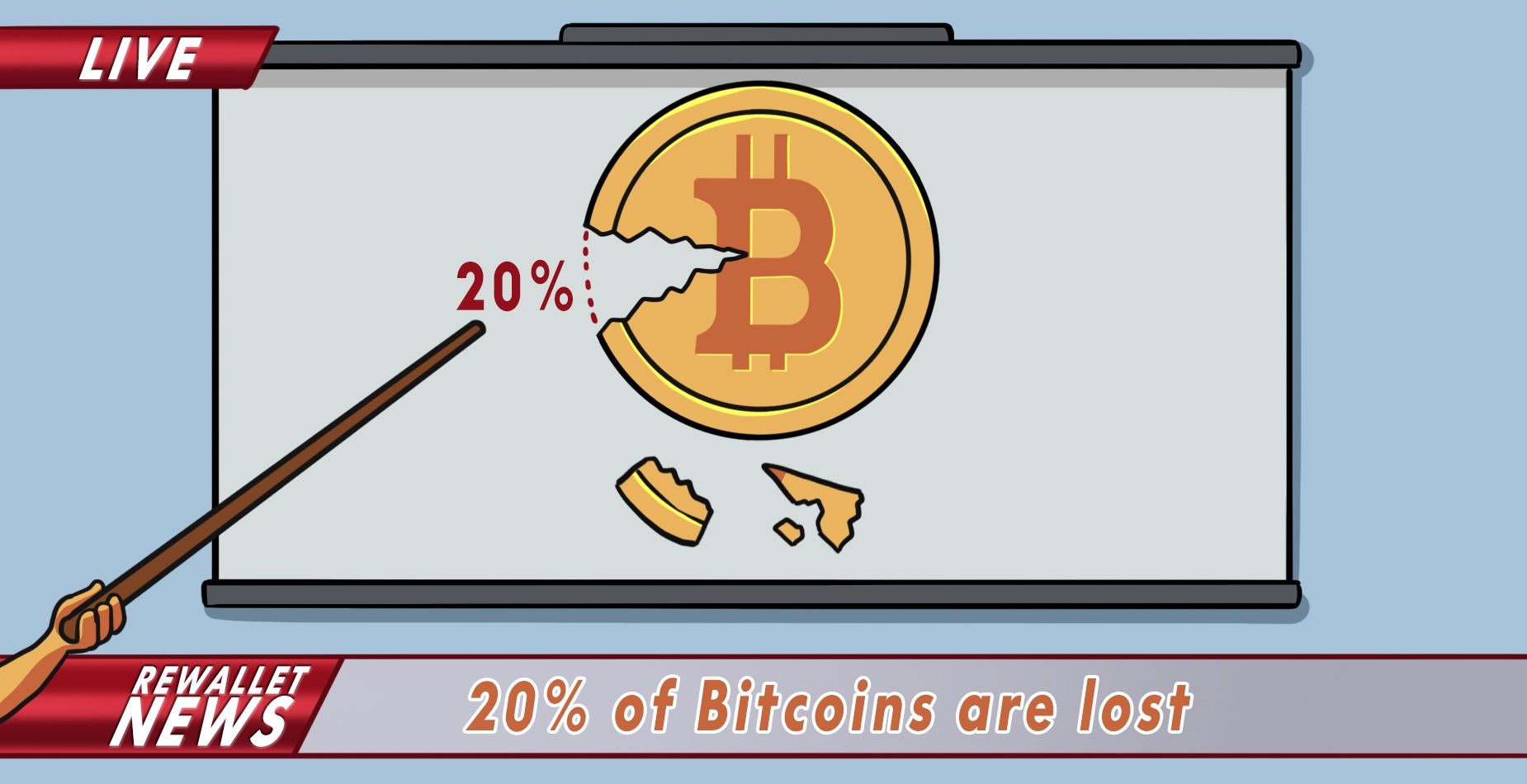
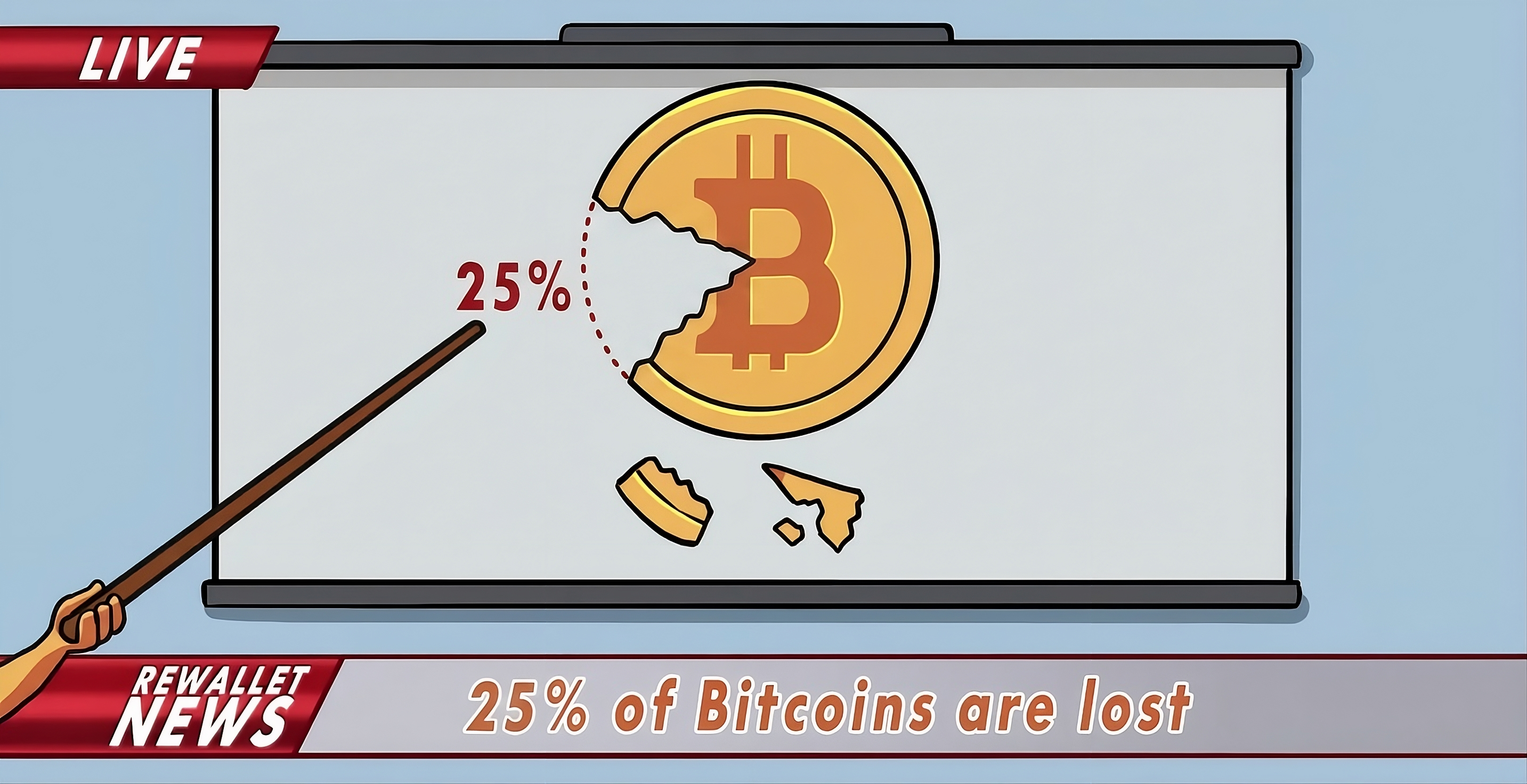
- Around 25.7% - roughly a quarter of all Bitcoin has not moved in seven years and is likely lost - up from 20% in our 2023 study.
- That dormant supply is worth roughly 335 billion US dollars at today's price, more than three times the ~100 billion USD it represented in 2023.
- 5.15 million BTC have sat untouched for seven years or more; on a five-year horizon the figure rises to 6.34 million BTC (31.7% of all BTC supply).
- The dormant share is growing even as half a million new coins have been mined since 2023.
- The likely explanation: while institutions accumulate under professional custody, the individual self-custody base has stalled and shows early signs of shrinking. It is these older, individual wallets where most “lost” Bitcoin sit.
Dear Journalists, All charts and underlying data are available upon request. Please contact us at team@rewallet.com.
Three years ago we published the first study in our 2023 Lost Bitcoin study. At the time Bitcoin traded at around 25,000 dollars and the idea of a public company holding billions in BTC on its balance sheet, for example, was still a novelty. A lot has changed since then. Consider where things stand today:
- Bitcoin's price has roughly tripled, sitting near 65,000 dollars with a market cap of around $1.3 trillion.
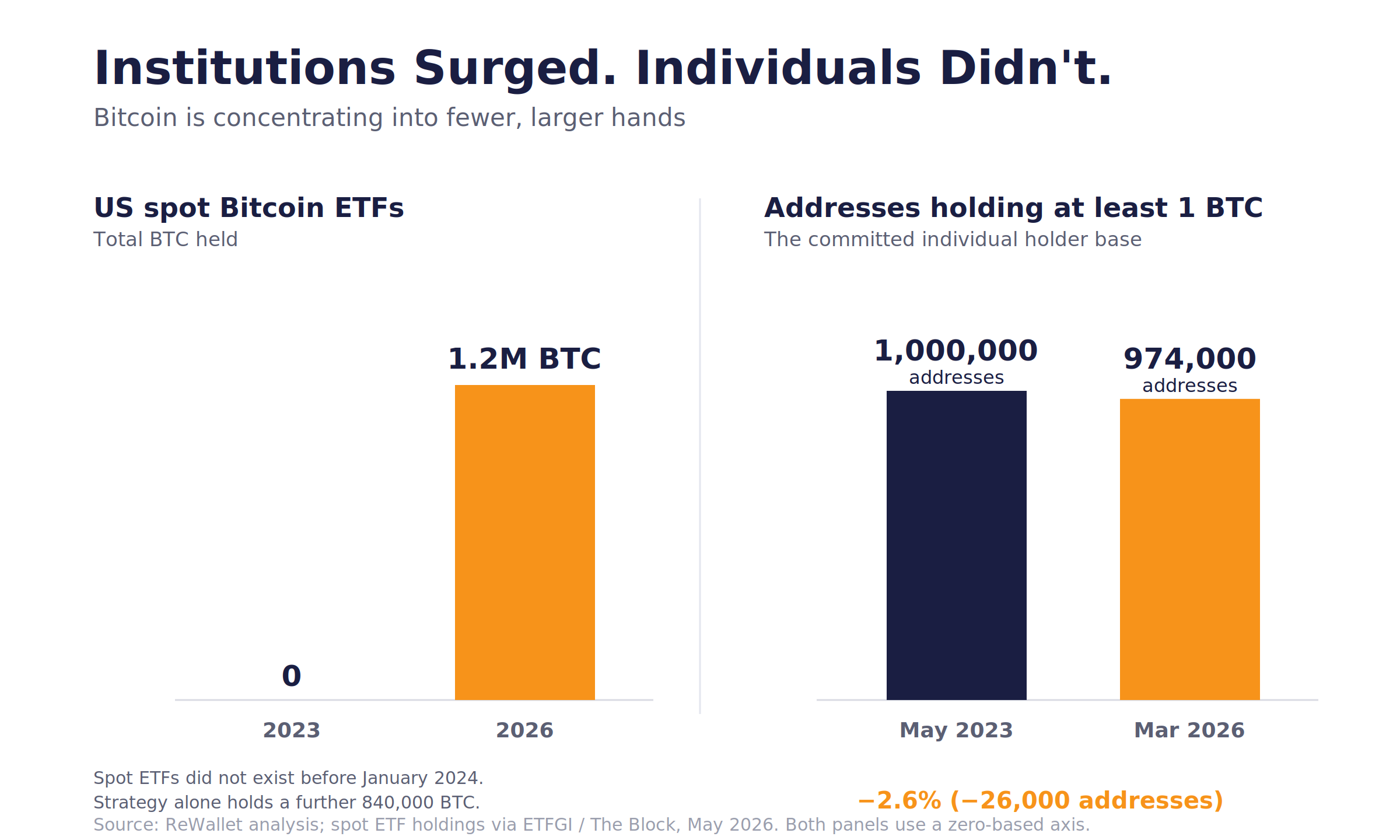
- Spot Bitcoin ETFs launched since January 2024 hold roughly 1.2 million BTC between them.
- A single Bitcoin treasury company, Strategy, has accumulated more than 840,000 BTC — close to four percent of all the Bitcoin that will ever exist.
By almost every measure Bitcoin has grown: more valuable, more widely held and more deeply embedded in the financial system than it was in 2023.
So three years on, we wanted to revisit our original analysis and ask the central question: Is more or less Bitcoin lost, and what is all that lost Bitcoin actually worth today?
How Bitcoin Has Evolved Since 2023
The Overall Picture
Three years on, Bitcoin has grown by almost every measure. When we published our first study the price sat at around 25,000 dollars. Today it trades near 65,000 dollars, with a total market value of roughly 1.3 trillion. The number of Bitcoin in circulation has risen too, from about 19.48 million BTC to just over 20 million as the last of the supply is slowly mined toward the 21 million cap. But who actually holds all this Bitcoin has changed just as much as the price, and that split matters for the rest of this story.
Institutions Accumulating More BTC
The biggest shift since our last study is the arrival of large institutional holders. In January 2024 the first spot Bitcoin ETFs were approved in the United States, giving everyday investors a way to gain exposure to Bitcoin through a regular brokerage account. Together these funds, run by names like BlackRock, Fidelity and Grayscale now hold around 1.2 million BTC between them.
Individual companies have moved in as well. Strategy, the most prominent example, has built up a treasury of more than 840,000 BTC, close to four percent of all the Bitcoin that will ever exist.
What these holders have in common is how carefully they store their coins. Institutions rely on professional custody services, multi-signature security and legal safeguards designed for exactly this purpose. As a result they very rarely lose access to their Bitcoin.
Bitcoin Concentrates in Fewer Hands
Alongside the institutions sits a much larger group of private holders. In our first study we tracked this group using two measures, and we return to both here. The first is the number of Bitcoin addresses holding more than one dollar worth of BTC. Because Bitcoin balances can also be denominated in satoshis (the smallest unit, with 100 million satoshis making one Bitcoin) rather than in dollars, we set a satoshi threshold matching one dollar at each snapshot date. On 31 May 2023, with Bitcoin trading near 25,000 dollars, one dollar corresponded to roughly 3,700 satoshis. Counting every address holding at least that amount, our analysis identified 40,040,309 funded addresses — a figure in line with the roughly 40 million reported by BitInfoCharts at that time. Repeating the same method in March 2026 returns roughly 48.8 million funded addresses.
On the face of it, the base of people holding at least a small amount of Bitcoin has grown. This figure should be read with care, though, because the threshold is measured in dollars. As the BTC price rises, more very small addresses are pulled over the one-dollar line, so part of this increase reflects the higher price rather than new holders.
The second measure is more telling, because it does not suffer from the same distortion. One Bitcoin is one Bitcoin whatever the price, so counting addresses that hold at least a whole coin gives a far cleaner picture of committed holders. In May 2023 that number surpassed one million for the first time, a milestone widely noted at the time. By March 2026 it has slipped back below it, to around 974,000 addresses.
This is where the two measures pull apart, and the contrast is the real finding. The dollar-based count rose, but as explained above, a tripling price alone can account for that — countless tiny addresses that sat just below one dollar in 2023 were lifted over the line by 2026 without any new holder behind them. The whole-coin count cannot be inflated this way, and it fell. Taken together, the most plausible reading is not that the individual holder base grew, but that it thinned: the apparent rise in small addresses largely reflects the higher price, while the genuine, whole-coin and typically self-custody base slightly contracted.
Set against the institutional surge, the picture comes into focus. Bitcoin is concentrating into a smaller number of very large institutional and custodial holdings, while the population of individuals holding meaningful amounts of their own coins has stalled.
Private individuals typically store their own Bitcoin without professional help, often relying on a single seed phrase written on paper, a backup file on an old device or a password they expect to remember. It is a far more fragile setup, and it is overwhelmingly this group — not the institutions — that ends up losing access to their coins.
The Updated Numbers — Our 2026 Findings
25.7% of All Bitcoin in Circulation is Likely Lost
According to our latest analysis around 25.7% of all Bitcoin currently in circulation is likely lost. To arrive at this figure we used the same methodology as in our first study, scanning all addresses on the Bitcoin blockchain. Using transaction and age metrics we found that 5.15 million BTC have not been moved for seven years or more. With current circulation at 20.01 million BTC this equals to a share of 25.7%. It is impossible to know exactly how many of those Bitcoin are being hoarded, how many might be recoverable and how many are lost for good. As many "missing" Bitcoin date from the very early days of the technology, when the value was very low, it stands to reason that the corresponding private keys may have long been lost.
The 5.15 million BTC mark a clear rise from our first study, when 3.84 million BTC, or 20% of a smaller 19.48 million supply, had been untouched for seven years or more. The dormant share has grown even as half a million new BTC have been mined.
When evaluating the results it is important to keep in mind that we have not accounted for any Bitcoin lost within the last seven years. It is also worth noting that our figures ignore Bitcoin that have been stolen, as those remain in circulation. Considering Bitcoin's price is approximately 65,000 dollars at the time of writing, the 5.15 million lost BTC represent a value of around 335 billion dollars — over three times the roughly 100 billion they were worth in 2023.
31.7% of Bitcoin in Circulation Hasn't Moved in 5 Years
When we apply the same methodology and analysis to a five-year time horizon we find that 6.34 million Bitcoin have not been moved for five years or more. With current circulation at 20.01 million BTC this equals 31.7% of all Bitcoin currently in circulation, up from 28% three years ago.
It goes without saying that, just as with the seven-year time horizon, it is not possible to fully separate the Bitcoin owned by someone playing a very long waiting game from those whose owners have lost their access.
When assessing these effects it is important to consider that we have not accounted for any Bitcoin lost within the last five years. As with the seven-year horizon, our figures ignore Bitcoin that have been stolen, as those remain in circulation. In dollar terms, 6.34 million Bitcoin represents around 412 billion dollars at the price of 65,000 dollars at the time of writing, well above the roughly 140 billion dollars it represented in 2023.
More Lost, or Less? The Value Question
So, three years on, is more Bitcoin lost or less? The data points in a consistent direction, but it pays to be precise about what it can and cannot tell us.
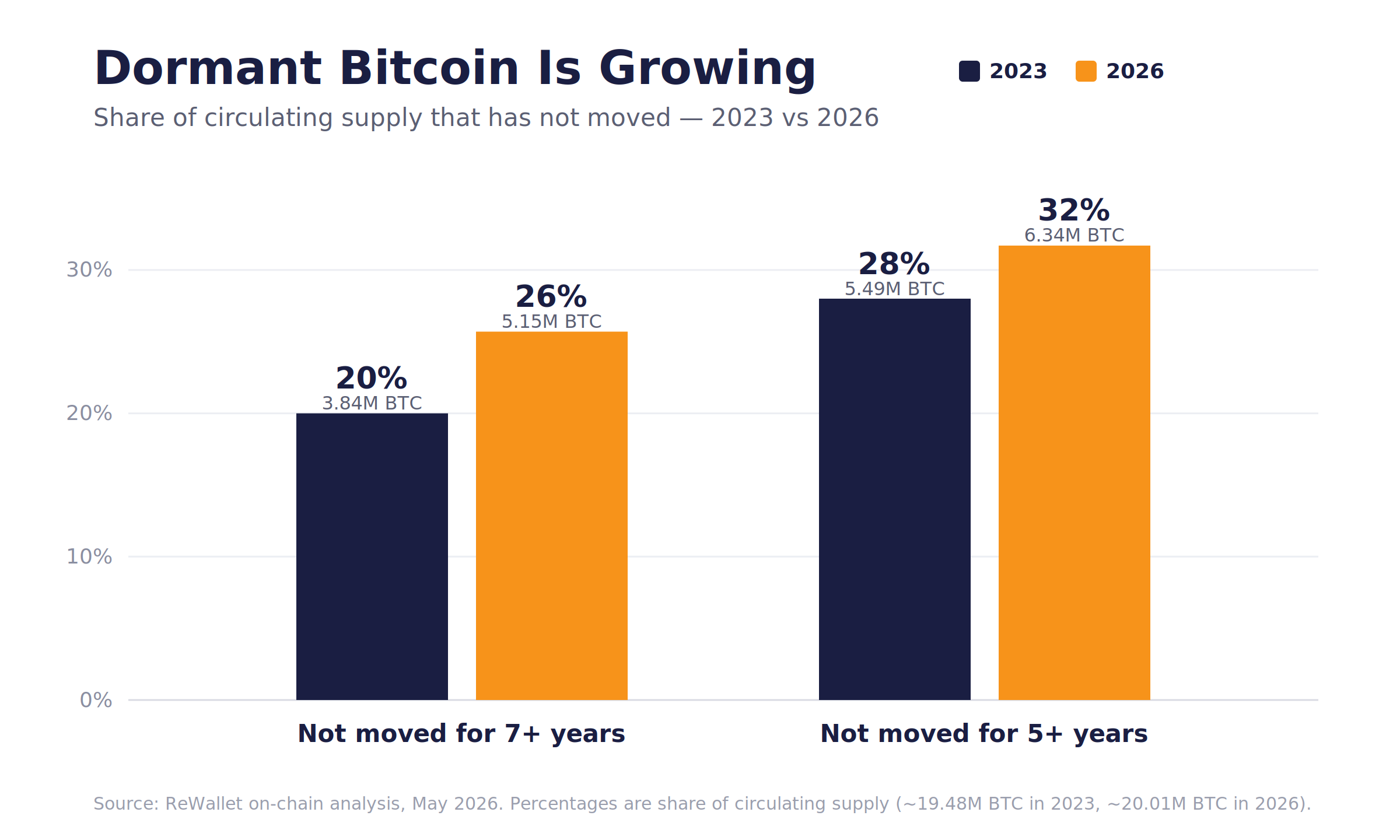
What is clear is that the pool of long-dormant coins has grown, in absolute terms and in value alike. A larger share of all Bitcoin now sits untouched than it did in 2023, on both the five and seven-year horizons and at today's prices that dormant supply is worth several times what it was. This sits alongside the shift we saw earlier: the whole-coin self-custody base has not grown while Bitcoin concentrates into a smaller number of very large institutional holdings.
Put these threads together and a coherent picture emerges. On one side, professionally managed institutions now hold a large and growing share of all Bitcoin, stored under custody arrangements that rarely fail. On the other, the population of individuals holding meaningful amounts of their own coins has stopped growing and shows first signs of shrinking. Running underneath both, an ever-larger pool of coins sits motionless for years.
That combination matters for where the lost Bitcoin actually is. Institutions rarely lose access, so the dormant coins are likely to be a deliberate long-term hold, and most likely to be genuinely lost, concentrated in the older, individual, self-custodied wallets. These are the wallets set up years ago by people who wrote a seed phrase on paper or saved a backup to a drive they no longer use. As Bitcoin grows more valuable and the individuals behind it become a smaller and more isolated group, the case for recovery, for a way back into wallets that would otherwise stay closed forever, only grows stronger.
Can Wallet Recovery Services Move the Needle?
It is worth asking whether any of this is reversible. Can professional recovery services meaningfully reduce the amount of Bitcoin that is permanently lost? For some addresses, honestly, no. Where a key has been completely lost and no backup, fragment or trace of information survives, the Bitcoin are gone and no recovery expert can change that. That is a mathematical property of how Bitcoin works, not a limitation any company can engineer around.
But a share of "lost" Bitcoin is not lost in that absolute sense. It sits behind a forgotten password, a seed phrase with a few missing or uncertain words, a corrupted wallet file, or an old device that no longer functions. In these cases the information needed to recover the funds still exists, in part or in a form that can be worked with. This is precisely the situation most of our clients find themselves in, and it is where recovery is possible.
That is the work we do at ReWallet. We help individuals regain access to wallets they had given up on, using the partial information they still have. As the value locked away in forgotten and inaccessible wallets climbs, the case for at least checking whether recovery is possible has never been stronger. If you have lost access to a Bitcoin wallet, or are not sure whether what you have is enough to recover it, you are welcome to get in touch. We will give you an expert assessment of your options.

Lost your BTC? ReWallet can help!
Whether you’ve forgotten your password, your recovery seed phrase isn’t working or you’re experiencing any other technical problems with your wallet, you've come to the right place.
Recover your wallet